Anion exchange membrane
This product series feature a polyaryl main-chain design, combining high strength and high alkali resistance. As a high-performance film, it is widely used in electrochemical energy conversion (water electrolysis, CO₂ reduction, flow batteries, ammonia synthesis) and extends to be used in water treatment.
The company’s second-generation AEM, PAW-2-80, has achieved large-scale production. Compared to the first generation, it offers major improvements in hydrogen permeation control and anti-swelling, while delivering an excellent balance of ionic conductivity, long-term alkali stability, mechanical strength, and gas barrier properties-ranking among the industry’s top.
Customization services are available for all products, supporting flexible film thickness and width options to meet diverse customer needs.
Technical Specifications
|
Type |
PAW-1-60 |
PAW-1-80 |
PAW-2-80 |
|
Thickness |
60 μm |
80 μm |
80 μm |
|
Web Width |
78 cm (up to 120 cm) |
||
|
Tensile Strength |
~50 MPa |
~50 MPa |
~60 MPa |
|
Elongation |
~80% |
~80% |
~70% |
|
Ion Exchange Capacity |
2.2 mmol/g |
2.2 mmol/g |
2.1 mmol/g |
|
Ionic Conductivity |
~180 mS/cm |
~180 mS/cm |
~150 mS/cm |
|
Swelling Ratio |
≤ 20% |
≤ 20% |
≤ 15% |
|
Moisture Absorption |
~40% |
~40% |
~30% |
|
Characteristic |
Excellent electrochemical performance |
Excellent electrochemical performance |
Overall performance balance |
|
Alkali Resistance |
High alkali resistance. After being immersed in 1 M NaOH solution at 80℃ for 10,000 hours, the loss of ionic conductivity is ≤ 5-7%.
|
||
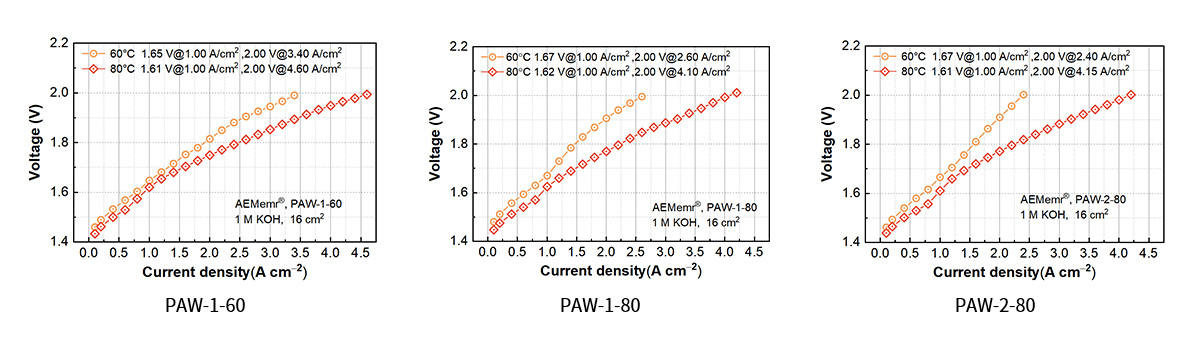
Polarization performance test of AEM in electrolyzing water
Usage Instructions
The AEMemr® series of anion exchange membranes are shipped as Br− type rolls and can be ion-exchanged to any anion as needed. Taking conversion to the OH− type as an example, the procedure is as follows:
1. Ion Exchange
Method 1: Exchange at room temperature
At room temperature, immerse the membrane in a 1 M KOH (or NaOH) solution (alkali volume ≥ 2 mL cm−2) and let it stand for 48 hours; replace the alkali solution once during this period (after approximately 6 hours).
Method 2: Exchange at Elevated Temperature
Soak the membrane in a 1 M KOH (or NaOH) solution at 50°C for 48 hours, replacing the alkali solution once during this period.
Note: Before immersing a dry membrane in the alkaline solution, secure all four corners and immerse it evenly to prevent curling.
2. Rinsing to Remove Alkali
After the replacement process is complete, repeatedly soak and rinse the membrane with deionized water, changing the water at least three times within 8 hours, until pH test strips indicate that the rinse solution is neutral.
3. Storage Procedures
After washing, OH− type membranes can be stored long-term in either a wet or dry state as needed:
① Wet storage: Place the membrane in a sealed bag with a small amount of deionized water and store at room temperature away from light.
② Dry storage: Use lint-free paper to blot the moisture from the AEM membrane’s surface, allow it to air dry naturally in a clean environment (approximately 3 hours), then place it in a sealed bag and store at room temperature away from light.
4. Precautions
① If residual alkaline solution is not thoroughly rinsed from the AEM membrane, operation under high-temperature, dry conditions is strictly prohibited, as this will cause irreversible damage to the membrane structure.
② This product swells significantly in alcoholic organic solvents; therefore, its use as a methanol fuel cell separator is not recommended at this stage.
If you have any business inquiries or would like to discuss technical matters, please feel free to contact us at any time.
Telephone: 0086-556-5689901
Email: zhuhongfang@polyrocks.com
Official Taobao Store: Guangdong Polyrocks Research Institute