【 Nature Catalysis Literature Sharing Research 】 25000 hours of ultra long stability! Further development of green hydrogen industrialization
Who is still saying that non precious metal catalysts cannot withstand industrial high currents and have a short lifespan?
The team of Academician Sun Licheng from Xihu University recently published a heavyweight achievement in Nature Catalysis, presenting an almost perfect industrial hydrogen production cathode solution - h-Ni/MoO ₂ encapsulated electrocatalyst.
Without the use of precious metals such as platinum and ruthenium, the low-temperature and simple preparation process can be scaled up to 20 cm × 20 cm large-area electrodes; Stable operation for over 25000 hours (more than two years) under ultra-high current density of 1000 mA cm ²; The anion exchange membrane electrolysis cell equipped with this catalyst has a current density of 5.6 A cm ² directly at 1.8 V voltage, far exceeding the hydrogen production performance target of the US Department of Energy (DOE) in 2026!
Today, this article will break down this top tier black technology and understand how it simultaneously addresses the four major industry pain points of activity, stability, scalability, and cost.
1、 Industry pain point: AEM electrolysis of water for hydrogen production, bottleneck problem to the endInWhere is it?
First understand the background: Anion exchange membrane water electrolysis (AEM-WE) is a low-cost green hydrogen core route, suitable for alkaline environments, low equipment costs, and renewable wind and solar power. It is a key technology for decarbonization in chemical, metallurgical, and transportation industries.
But in the past, the industrialization of AEM has been trapped by three major bottlenecks of cathodic hydrogen evolution (HER) catalysts:
1. Under high current, the activity drops sharply: conventional NiMo materials and commercial Pt/C, with overpotential soaring at 1 A cm ⁻ ² high current, resulting in high energy consumption;
2. Life cliff like decay: Hydrogen gas bubbles released at high speed violently impact the catalyst, causing material peeling off; Mo components are prone to alkali corrosion and dissolution, while active metals are exposed and lost; The performance of commercial platinum carbon drops by 400 mV directly after 1500 hours;
3. Difficulty in scaling up and high cost: Hydrothermal and electrodeposition synthesis require high temperature and energy consumption, and precious metal catalyst raw materials are expensive and cannot be mass-produced.
At present, the mainstream solutions either have sufficient activity but short lifespan, or stability but explosive cost. The triangle contradiction of activity stability cost is always difficult to balance, which is also the core breakthrough point of this work.
2、 Core black technology: heterogeneous nucleation low-temperature synthesis, unique structure of "MoO ₂ armor encapsulated Ni nanoparticles"
Adopting a two-step mild synthesis method, it can be mass-produced with low temperature and energy consumption throughout the entire preparation process, fully suitable for industrial expansion:
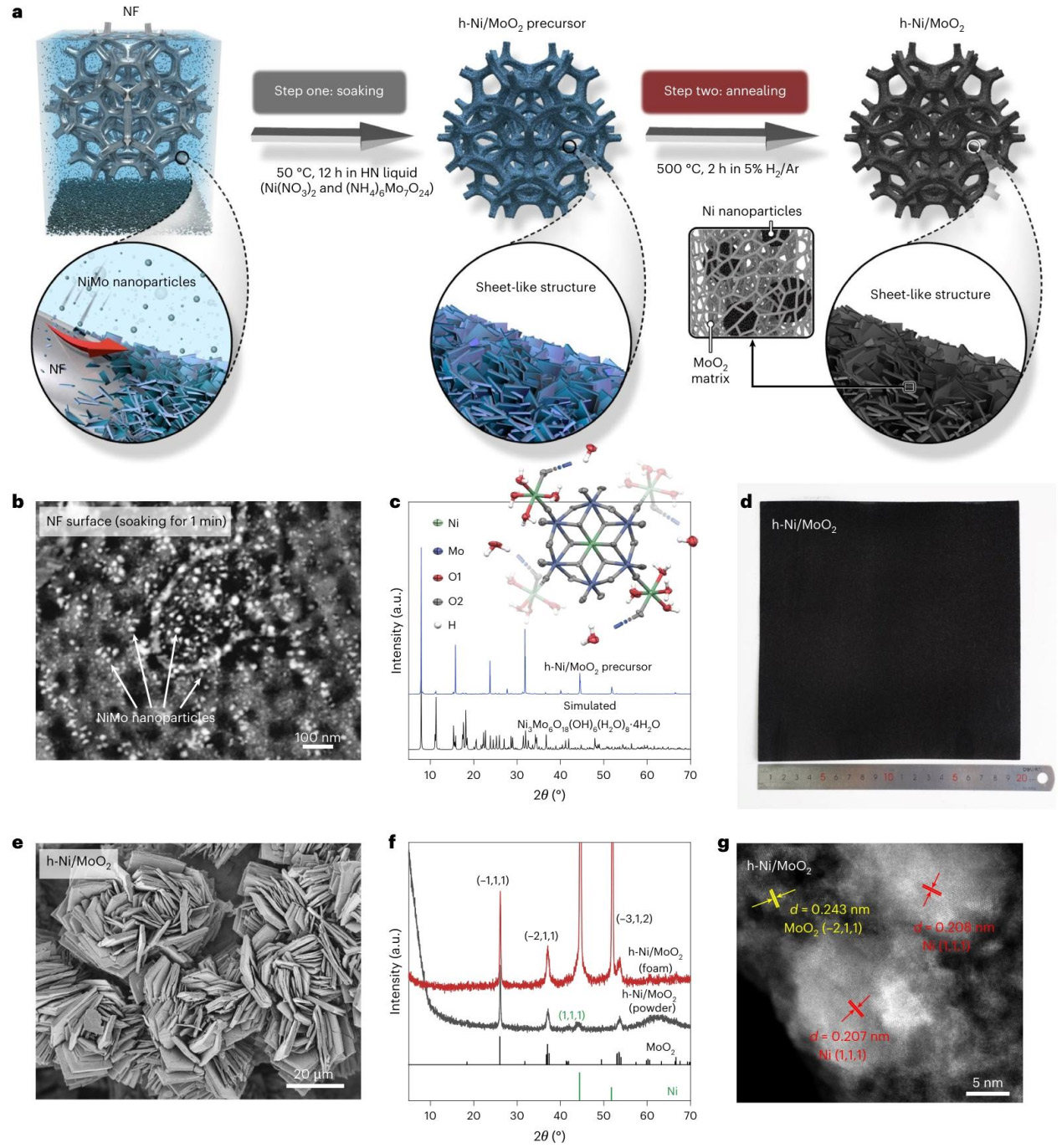
The first step is to use low-temperature heterogeneous nucleation soaking (50 ℃, 12 h), followed by weak reduction annealing (500 ℃, 5% H ₂/Ar, 2 h)
✅ Mass production advantage: It can prepare large-area integrated electrodes of 20 cm × 20 cm in a single operation, with a raw material cost of only about 53.5 US dollars per square meter, which is a huge gap compared to platinum carbon catalysts that cost thousands of US dollars per square meter.
Through encapsulation structure and dual buff stacking of performance: ordinary NiMo catalysts have metal particles exposed on the material surface, while h-Ni/MoO ₂ in this article is a MoO ₂ porous skeleton used as a "protective armor":
1. A large number of Ni MoO ₂ heterojunction interfaces are buried internally: DFT theoretical calculations confirm that MoO ₂ is responsible for rapid adsorption and dissociation of water molecules, and metal Ni efficiently couples with hydrogen atoms to generate hydrogen gas, synergistically reducing the reaction energy barrier;
2. Mesoporous hydrophilic channel: The material is super hydrophilic, allowing electrolyte to quickly penetrate the interior and hydrogen gas bubbles to quickly detach, avoiding bubble accumulation and impact on the material;
3. Physical and chemical dual protection: MoO ₂ matrix isolates strong alkaline electrolyte, greatly inhibiting the dissolution of Mo components and the detachment of Ni particles. 3D reconstruction of installation structure and mechanical testing diagram
3、 Explosive performance data: laboratory→Full dimensional compaction of traditional catalysts in electrolytic cells
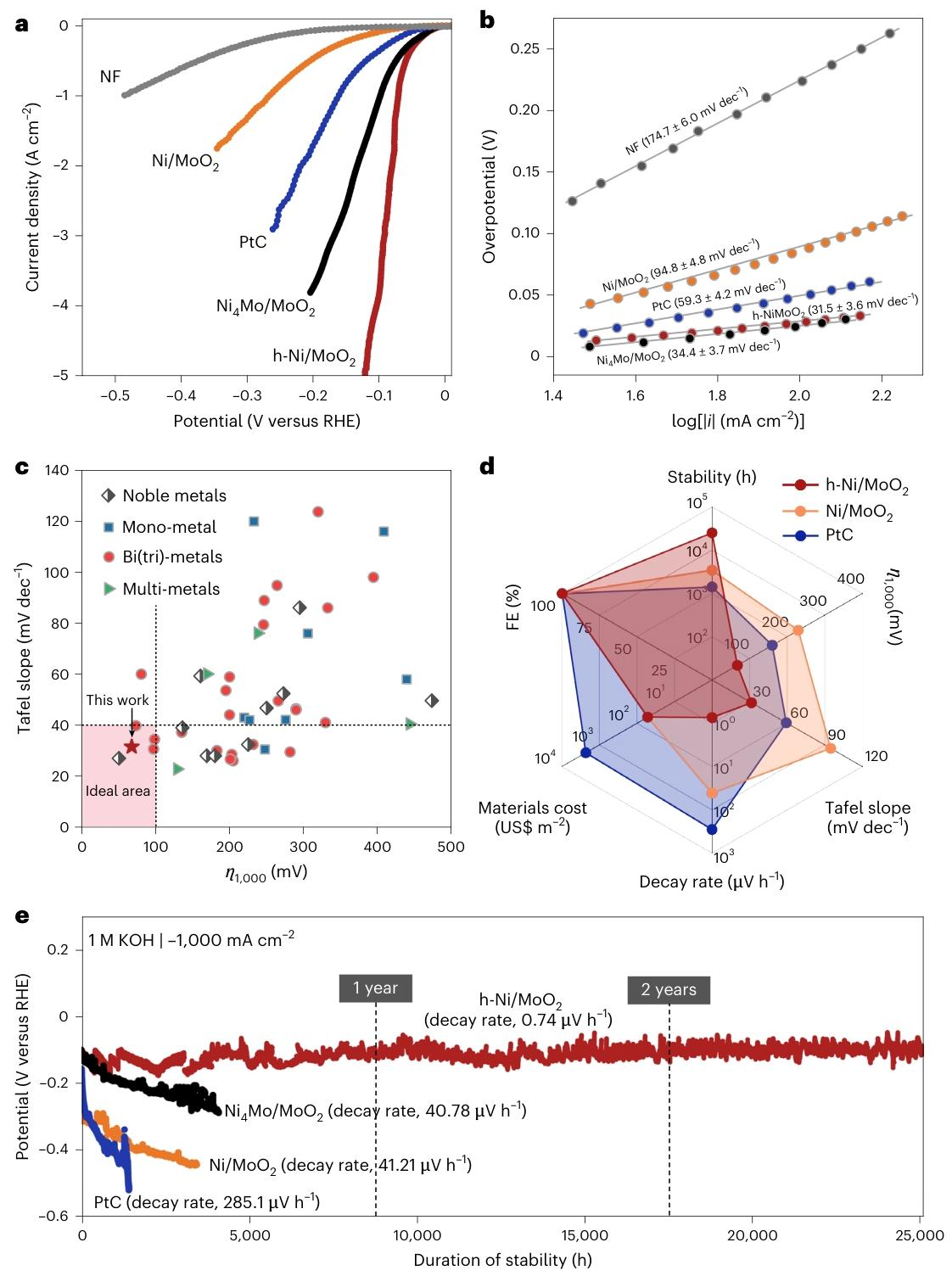
Hydrogen evolution performance based on three electrode system (1 M KOH alkaline system)
1. Ultra low overpotential: Only 70.9 ± 4.5 mV overpotential at 1000 mA cm ² industrial grade high current; Compared to commercial Pt/C, which can reach up to 160.4 mV during the same period, traditional hydrothermal Ni ₄ Mo/MoO ₂ also requires 98.4 mV;
2. Ultrafast reaction kinetics: The Tafel slope is only 31.5 mV dec ⁻¹, approaching the catalytic limit of precious metals; At an overpotential of 120 mV, the current density can reach 5 A cm ², which is more than 9 times that of platinum carbon;
3. Epic level long-term stability: tested continuously for 25000 hours (over 2 years) with a constant current of 1 A cm ⁻ ², the decay rate is only 0.74 μ V h ⁻¹;; compared to the platinum carbon group, which decayed 285.1 μ V h ⁻¹ after 1500 hours and failed directly after thousands of hours;
4. Intermittent working condition tolerance: There is no significant performance decline after 50000 start stop cycles, perfectly matching the fluctuating working conditions of wind and solar power generation.
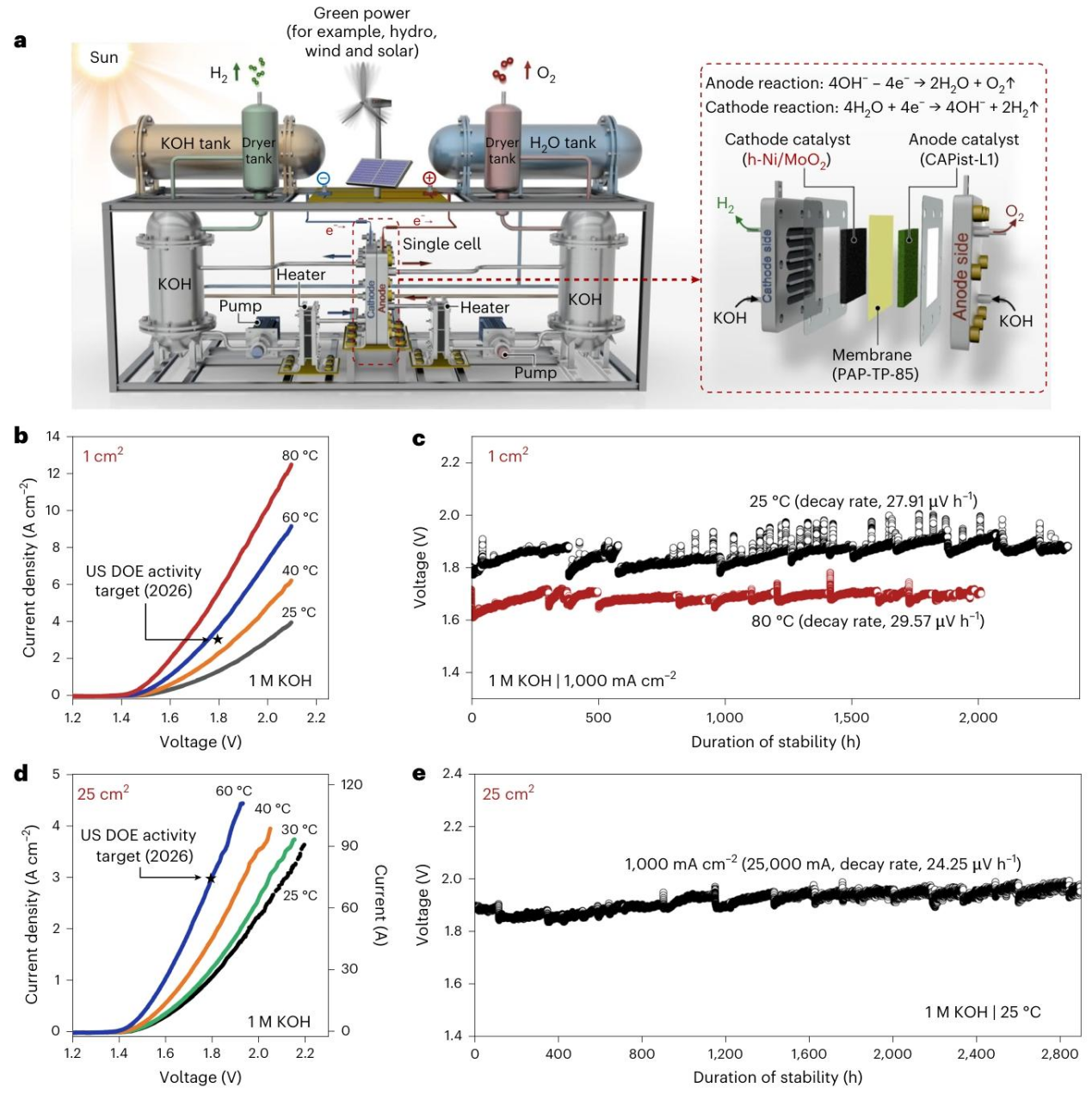
Actual AEM electrolytic cell overall performance (industrial core verification)
The team built two sizes of single slots, 1 cm ² and 25 cm ², with NiFe based OER anode and polyarylpyridine anion membrane for actual testing:
1. Breakthrough the US DOE 2026 target for activity: At 80 ℃ and 1.8 V cell pressure, the current density of a small electrolytic cell is 5.6 A cm ⁻ ²; the 2.0 V voltage directly exceeds 10.2 A cm ⁻ ²; after amplification to a 25 cm ² large electrode, the 1.8 V still reaches 3.01 A cm ⁻ ², meeting industrial standards;
2. Long term stability of the whole machine: 1000 mA cm ⁻ ² constant current, 1 cm ² electrolytic cell stable at 80 ℃ for 2000 hours, 25 cm ² amplification cell stable at 2800 hours; Faraday efficiency close to 100%, hydrogen production energy consumption as low as 4.07 kWh/Nm ³, hydrogen production energy efficiency of 73.9%;
3. Economic calculation: Based on the technical and economic model, the LCOH of hydrogen production after scaling is as low as 1.826 US dollars/kgH₂Meet the cost targets of $2/kg by the US DOE in 2026 and $2.5/kg by the EU in 2030.
4、 Mechanism analysis: Why can encapsulation structures achieve both high activity and ultra long lifespan simultaneously?
The article provides a complete explanation of the long-term mechanism from three dimensions: mechanical stability, structural stability, and chemical stability, which is easy to understand and disassembled
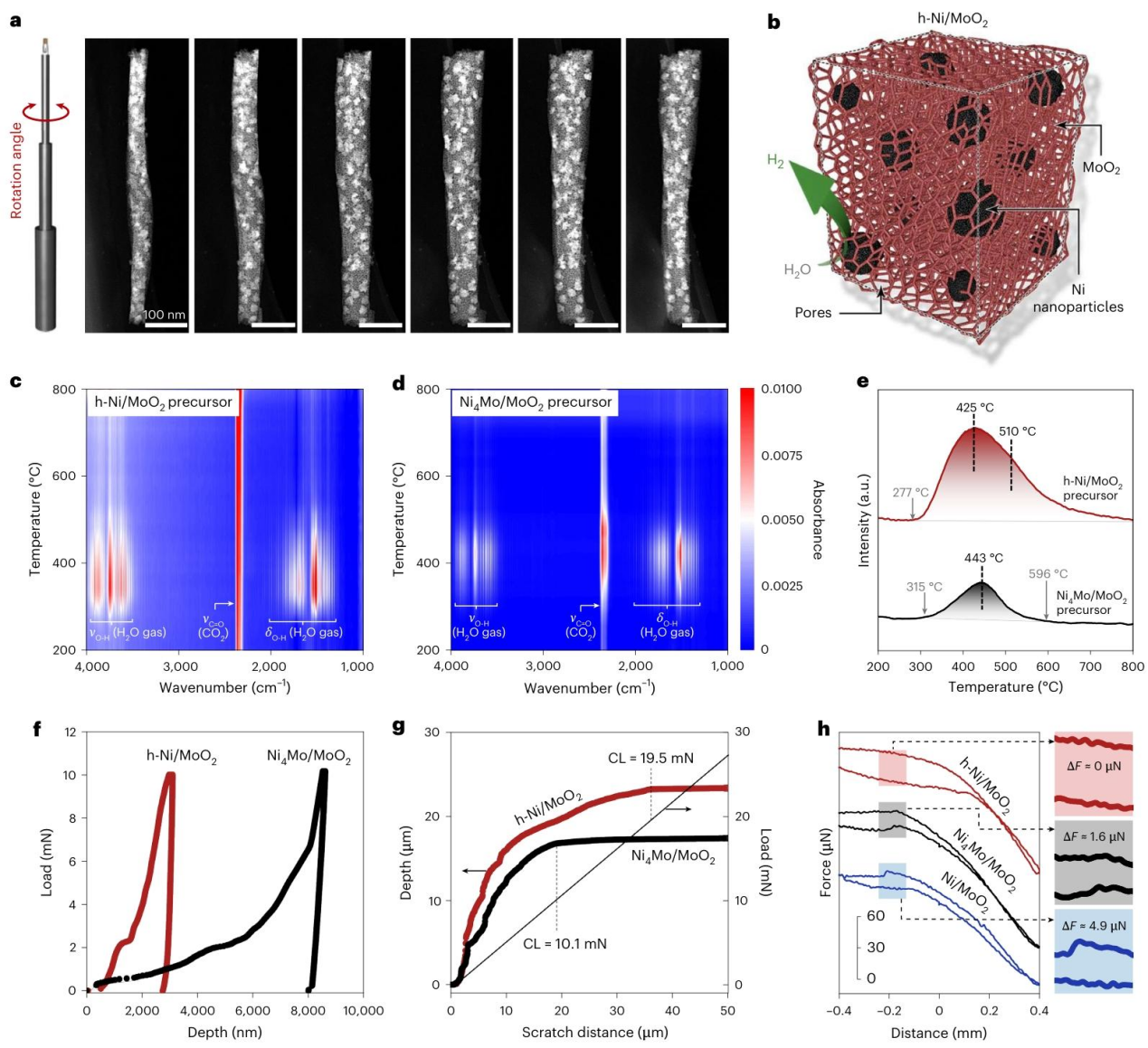
1. Mechanical stability: resistant to bubble impact and not easily broken
Interwoven micro layer structure+Ni particle dispersion enhances the mechanical strength of the material; Bubbles are easy to detach and have small sizes, greatly weakening fluid flushing. Long term electrolysis will not result in extensive catalyst stripping.
2. Structural stability: no loss of active components
MoO ₂ mesoporous skeleton wraps Ni nanoparticles, isolating the electrolyte from directly corroding the metal core; After long-term testing, there is almost no change in the size of Ni particles, and there will be no phenomenon of metal dissolution on the surface of traditional materials.
3. Chemical stability: inhibits molybdenum alkali dissolution
The encapsulation structure reduces the degree of cathodic corrosion, and the amount of Mo dissolved is much lower than that of exposed NiMo materials; The stability number (hydrogen producing molecules/dissolved Mo atoms) reaches 245560, which is 7 times that of traditional Ni ₄ Mo/MoO ₂, chemically locking in active sites.
4. High activity source: sufficient heterojunction+rapid mass transfer
Annealing releases water to form through mesopores, exposing a large amount of Ni MoO ₂ interface; The charge transfer resistance is extremely low, and the mass transfer resistance is almost not hindered under high current, solving the problem of high current polarization loss.
Summary
This work fills the gap of "high current, long life, low cost, and easy amplification" of non precious metal catalysts for AEM water electrolysis, with three major practical values.
In addition to electrolysis of water to produce hydrogen, this low-temperature heterogeneous nucleation synthesis strategy can also be extended to various electrocatalytic reactions such as CO ₂ reduction, 5-hydroxymethylfurfural reduction, nitrogen fixation, etc., and has universal material preparation value.
Original text: Nickel nanoparticles encapsulated inside mesopores MoO2for industrially stable anion-exchange membrane water electrolysis
DOI:10.1038/s41929-026-01585-w
Anhui Polyrocks Hydro-friend Technology Co., Ltd. is deeply engaged in the research and development of anion exchange membranes, AEMemr®Multiple scene tests have confirmed the performance advantage. Polyrocks Hydro-friend will continue to iterate membrane material products, in conjunction with the company's developed anionic polyelectrolyte material (AEMemr)®-PAI provides high-performance and highly stable AEM integrated solutions for hydrogen production equipment manufacturers, working together to accelerate the commercialization of AEMWE green hydrogen production.
Contact Information
Phone: 0086-556-5689901
Email: zhuhongfang@polyrocks.com
Address: Life Science and Technology Park, High tech Park, Anqing City, Anhui Province
Official Taobao store: Guangdong Polyrocks Research Institute
Store link: https://shop256001102.taobao.com