How does the assembly pressure of AEMWE affect the safety of "hydrogen in oxygen"?
In the research of anion exchange membrane water electrolyzer (AEMWE), people's attention is often focused on core materials such as membrane, catalyst, and gas diffusion layer. But there is one factor, seemingly simple but often overlooked, and that is——Mechanical pressure during assembly.
The pressure is reduced, the contact is poor, and the resistance is high; When the pressure is high, the membrane may break and gas permeation may intensify, directly threatening the concentration of hydrogen in oxygen (HTO) to exceed the standard.
So, what kind of pressure is' just right '? The team from the Forschungszentrum J ü lich research center in GermanyJournal of Power SourcesA systematic study was published, quantifying for the first time the comprehensive impact of mechanical pressure on AEMWE performance and gas permeation
1、 Where does pressure come from? The 'butterfly effect' caused by the thickness of a gasket
The research team designed a sophisticated experiment to control the pressure applied to the membrane electrode assembly (MEA) by changing the thickness difference (Δ d) between the PTFE sealing gasket and the electrode.
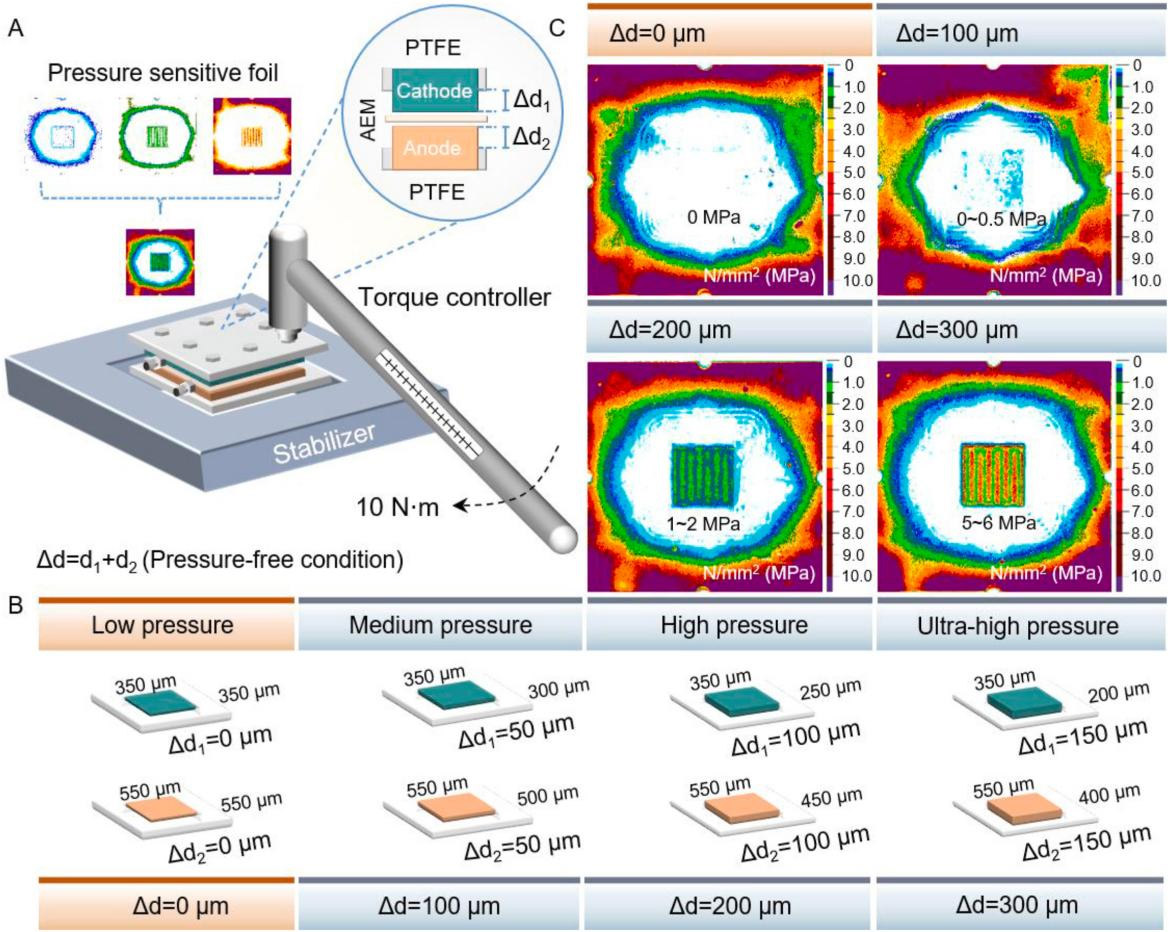
Through the color imprint of the pressure-sensitive membrane, it can be clearly seen that the pressure distribution is extremely uneven - the pressure around the screw is the highest (>10 MPa), while the pressure in the flow channel area is lower. This indicates that the torque of the screw and the thickness of the gasket jointly determine the true stress situation on the MEA.
|
Thickness difference/Δd (μm) |
Mechanical pressure/MPa |
may affect |
|
0 |
0 |
Poor contact, insufficient sealing, high risk of gas leakage |
|
100 |
0~0.5 |
Uniform contact, good sealing. Hydrogen is the lowest in oxygen |
|
200 |
1~2 |
The membrane begins to be damaged, and hydrogen permeation intensifies, leading to an increase in HTO |
|
300 |
5~6 |
Severe deformation, increased hydrogen permeability, and HTO exceeding the standard |
2、 How does pressure change electrodes? Anode is more sensitive than cathode
Pressure has a significant impact on the physical properties of electrodes, and the anode (nickel fiber felt) is much more sensitive than the cathode (carbon paper):
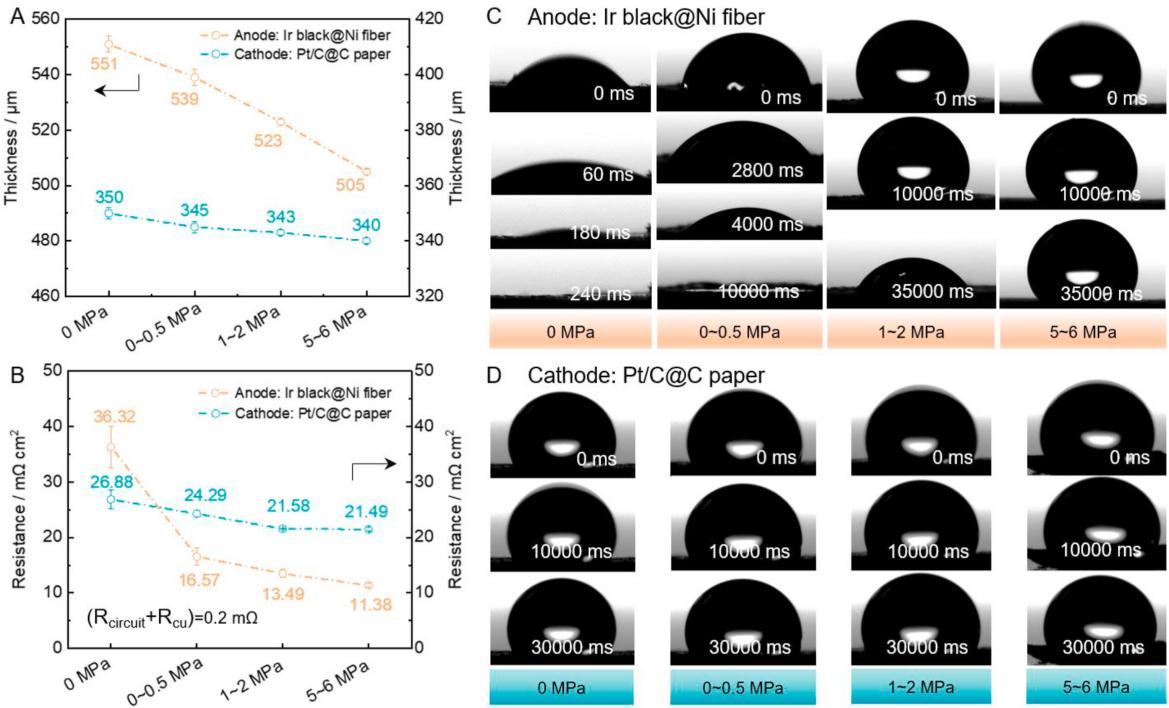
Thickness and resistance: From 0 to 5-6 MPa, the anode thickness was compressed by 8.35%, resulting in a 68.3% drop in bulk and contact resistance; And the cathode only decreased by 20.1%. This indicates that the nickel fiber structure of the anode is more likely to affect conductivity under pressure.
Wettability reversal (key!):The anode was originally superhydrophilic (water droplets fully spread within 240 ms), but under high pressure (5-6 MPa), its surface becomes difficult to wet (water droplets still do not spread after 35000 ms). This is caused by the flattening of the surface microstructure and the reduction of pores.
How does wettability reversal affect hydrogen in oxygen?
The decrease in anode wettability means that the spreading and discharge of water on the anode side are affected. In the "anode inflow" mode, if the hydrophilicity of the anode is disrupted by high pressure, uneven water distribution can lead to local "drying" or "flooding", both of which can interfere with the smooth progress of the anode oxygen evolution reaction (OER), causing pressure fluctuations and ultimately affecting gas separation efficiency.
More importantly, the loss of hydrophilicity of the anode weakens its ability as a "gas-liquid separation barrier", making it easier for hydrogen gas permeating from the cathode to mix into the anode oxygen stream, directly increasing the concentration of HTO.
3、 The 'Golden Pressure' has been released: 0.5 MPa or the balance point between performance and safety!
The research team tested membranes with thicknesses of 25 μ m and 50 μ m respectively, and the results consistently pointed to the same optimal pressure range. The hydrogen permeation data provided the most critical safety evidence (taking the 50 μ m membrane as an example):
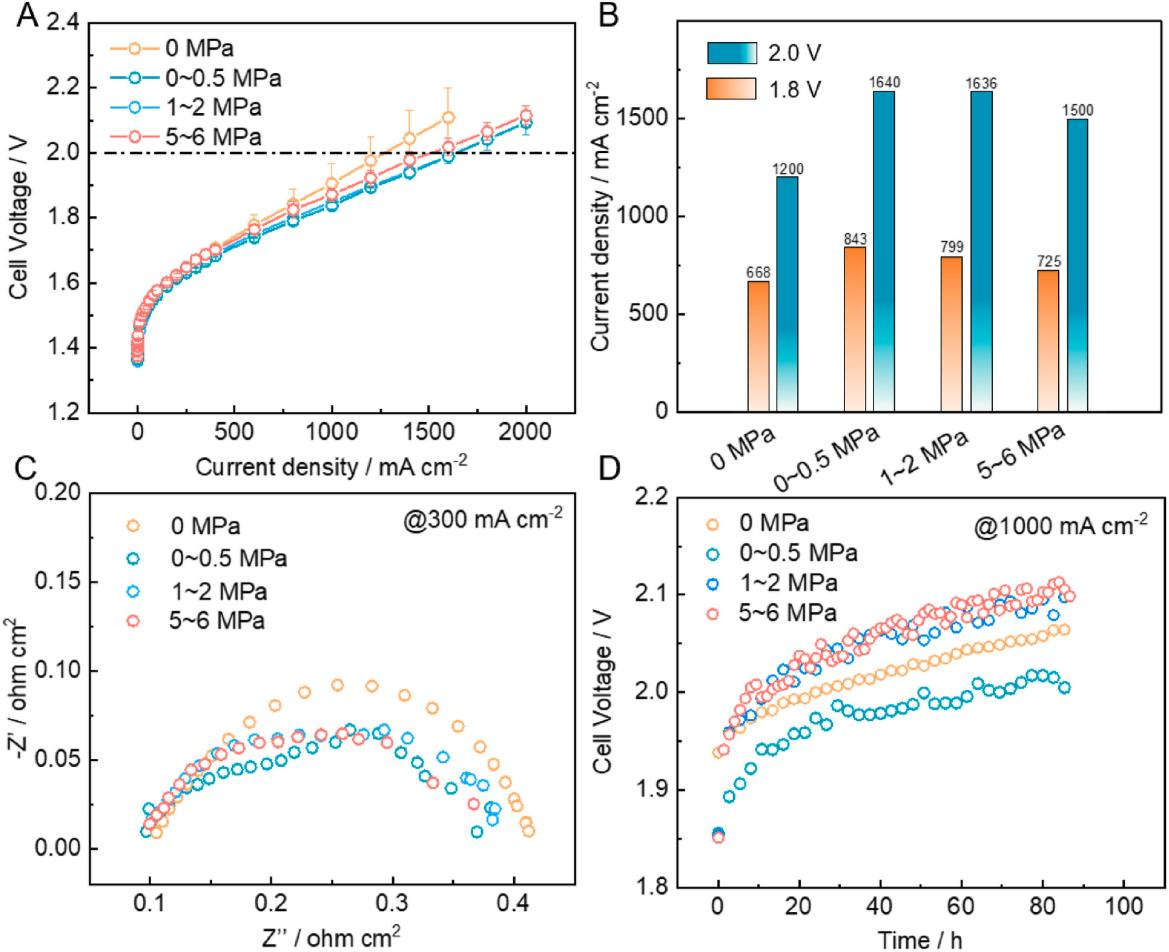
Low pressure (0 MPa): high contact resistance, poor performance, insufficient sealing leading to gas leakage.
Moderate pressure (0~0.5 MPa): halved contact resistance, significantly improved performance. The most critical factor is that the hydrogen permeability is below the safety standard line of 2%.
Excessive pressure (1-6 MPa):
For 25 μ m thin films, pressure exceeding 1-2 MPa can cause membrane damage and short circuits;
For a thick film of 50 μ m, the hydrogen permeability at 5-6 MPa is four times that of 0.5 MPa, directly leading to a concentration of "hydrogen in oxygen" far exceeding the safe upper limit of 2%.
4、 Practical suggestion: How to install an AEMWE and maintain safety bottom line?
Optimal pressure target:Controlling the true pressure on the MEA at around 0-0.5 MPa is the optimal balance point to ensure both performance and hydrogen safety in oxygen.
Film thickness selection:Recommend using a film with a thickness of ≥ 50 μ m. Thicker membranes not only provide higher mechanical strength, but more importantly, they can extend the path for hydrogen to penetrate the membrane, effectively suppress hydrogen permeation, and provide a physical defense line for the concentration of "hydrogen in oxygen".
Assembly technique:Adopting a step-by-step tightening method of "preloading unloading reloading" (e.g. 3 N · m first, then 5 N · m, and finally 7 N · m). This can make the pressure distribution more uniform and avoid membrane perforation caused by excessive local stress - any small perforation can become a "shortcut" for concentrated hydrogen permeation, directly triggering the "hydrogen in oxygen" crisis.
Summary
The assembly of AEMWE is not about 'tightening the better'. A delicate balance point can effectively compress the electrode, reduce contact resistance, and prevent excessive squeezing from worsening mass transfer and gas permeation.
More importantly, the direct causal relationship between mechanical pressure and the safety of "hydrogen in oxygen" has been proven through data: low pressure → inadequate sealing → gas leakage; Excessive pressure → membrane compression deformation → intensified hydrogen permeation → excessive hydrogen in oxygen.
DOI:10.1016/j.jpowsour.2023.233802
Anhui Polyrocks Hydro-friend Technology Co., Ltd. is deeply engaged in the research and development of anion exchange membranes, AEMemr®Multiple scene tests have confirmed the performance advantage. Polyrocks Hydro-friend will continue to iterate membrane material products, in conjunction with the company's developed anionic polyelectrolyte material (AEMemr)®-PAI provides high-performance and highly stable AEM integrated solutions for hydrogen production equipment manufacturers, working together to accelerate the commercialization of AEMWE green hydrogen production.
Contact Information
Phone: 0086-556-5689901
Email: zhuhongfang@polyrocks.com
Address: Life Science and Technology Park, High tech Park, Anqing City, Anhui Province
Official Taobao store: Guangdong Polyrocks Research Institute
Store link: https://shop256001102.taobao.com